 Whalesmarket
 settlement: delivery deadlines and default
Last updated -
Whalesmarket settlement completes a matched pre-market trade by delivering the agreed tokens and releasing the applicable payment. If delivery remains overdue after the applicable deadline, the buyer can cancel the unsettled order and claim collateral. The normal settlement window lasts four hours from activation, with infrastructure-related extensions handled separately. A missed deadline creates a cancellation right; it does not automatically end every order. Successful delivery, seller default, and market cancellation have different payment consequences.
Delivery while the order remains open
A buyer with an overdue order can wait for token delivery or claim the collateral available through cancellation. Before the deadline, the matched trade remains committed to settlement. After the deadline, the seller retains the right to deliver while that order remains unsettled and uncancelled. Waiting preserves that possibility, including after an overdue label appears. The choice applies to the matched order: delivery supplies its tokens, while a completed default claim releases the relevant escrow funds. A seller's assurance of delivery does not establish that the tokens have arrived.
Whalesmarket can also cancel an affected market when settlement cannot proceed. That action follows a separate refund treatment.
Allocation size, collateral, and payment
The allocation is the token quantity that the seller has undertaken to deliver, while collateral backs the matched obligation. In an original escrow-funded trade, both parties deposit an amount equal to the agreed trade value. The buyer's deposit funds the purchase and reaches the seller after successful settlement. The seller recovers the collateral for that settled portion, subject to fees. A resale transfers the original buyer's collateral rights to a new holder. The buyer-side cross-chain Claim flow has separate payment requirements.
When does the settlement deadline begin?
Normal activation
Settlement activation starts the normal delivery clock once the token is officially listed on a market. TGE means token generation event. Matched orders cannot settle or use overdue cancellation before TGE. The deadline follows that market's activated settlement phase, rather than the date on which the pre-market order was filled.
The normal pre-market settlement window lasts four hours from activation. Normal activation requires claimable tokens, a settlement asset on the agreed chain, and a usable delivery route.
Upcoming Settlements shows the scheduled start, while Current Settlements includes settlement in progress. The market schedule supplies the token-specific timing; the normal four-hour rule should not replace an announced extension. When the interface labels a timestamp UTC, compare it in that time zone.
Infrastructure interruptions
Claim-portal or bridge outages
For a claim-portal or bridge outage, Extended Settlement pauses the timer and can extend the window by up to 48 hours. The extension applies when Whalesmarket activates that fallback for the affected market. A seller who simply lacks the tokens still faces the applicable delivery deadline.
No viable delivery route
If no viable bridge route exists, a temporary cross-chain settlement contract may provide another supported delivery path. When the disruption remains unresolved within the allowed period, Whalesmarket can cancel the affected market and return its escrows.
Direct settlement: Review, approval, and confirmation
A seller can inspect the required delivery before signing the transaction that authorizes settlement. The review can stop before wallet approval; the existing matched obligation remains in place. For direct delivery on the agreed chain, the final review concerns the selected order and the tokens that its buyer should receive.
- Confirm that settlement has started and the selected matched order remains unsettled and uncancelled.
- Connect the wallet that created or filled the order on the seller side.
- Match the available settlement token and quantity to the order's delivery requirement.
- Review the total required amount before approving the Settle request in the wallet.
- After confirmation, check the recorded token transfer against the buyer address, required amount, and order's Settled status.
Signing authorizes the settlement request. Successful blockchain confirmation, the recorded token transfer, and the matching Settled status establish completion. In this escrow-funded flow, that settlement releases the buyer's payment and the seller's collateral, after applicable fees.
Collateral claims after default or market cancellation
Seller default gives the buyer a claim on the seller's collateral; market cancellation returns the relevant escrows. The buyer must complete the overdue cancellation claim to receive the default payout.
An original escrow-funded buyer recovers their deposit plus compensation from the seller's collateral. Gross compensation equals the buyer's deposited trade amount. That amount follows the committed collateral, even if the token's launch price is higher. The default claim delivers funds without the purchased tokens.
Under the base pre-market cancellation schedule, a 2.5% fee applies to the buyer's deposit and another 2.5% applies to the seller's collateral. The contract deducts these fees when the buyer cancels for non-delivery. Gross escrow totals therefore differ from the net amount received.
When Whalesmarket cancels the market, the original buyer and seller each recover their own collateral. This cancellation does not award the seller's collateral to the buyer. A holder who acquired the buy position through resale instead retains the inherited collateral entitlement, which may cover less than the resale payment.
Cross-chain settlement and the asset that arrives
Cross-chain settlement can deliver a wrapped asset on the listing chain even when the original token exists elsewhere. The listing chain holds the orderbook and settlement transactions. The TGE chain holds the original tokens. Wrapping creates a representation backed 1:1 by original tokens locked in a contract.
Seller-led settlement with a wrapped balance
In the seller-led flow, a bridge is necessary only when the available wrapped balance cannot cover the specific order. That bridge locks original tokens on the TGE chain and supplies wrapped tokens on the listing chain. The seller authorizes a required bridge on the TGE chain. LayerZero must confirm the cross-chain message before settlement proceeds. With sufficient wrapped balance already available, this bridge step is skipped. After bridge confirmation, those original tokens remain locked and unavailable for reuse by the seller. The seller must then sign the settlement transaction. Successful settlement releases payment under that flow's contract rules and updates the order to Settled.
Payment and bridging in the buyer-side Claim flow
The buyer-side cross-chain Claim flow requires the payment token on the listing chain. In this flow, deposited collateral serves as a participation guarantee and remains separate from payment. Claim checks the network and balance, then requires the buyer's signature for payment to the seller.
The buyer must initiate the Bridge action manually to obtain the native asset on the TGE chain. Its receipt depends on completing that bridge and the required cross-chain confirmations. Selecting Claim does not automatically perform this native-asset transfer.
Settlement rights after a buy position changes hands
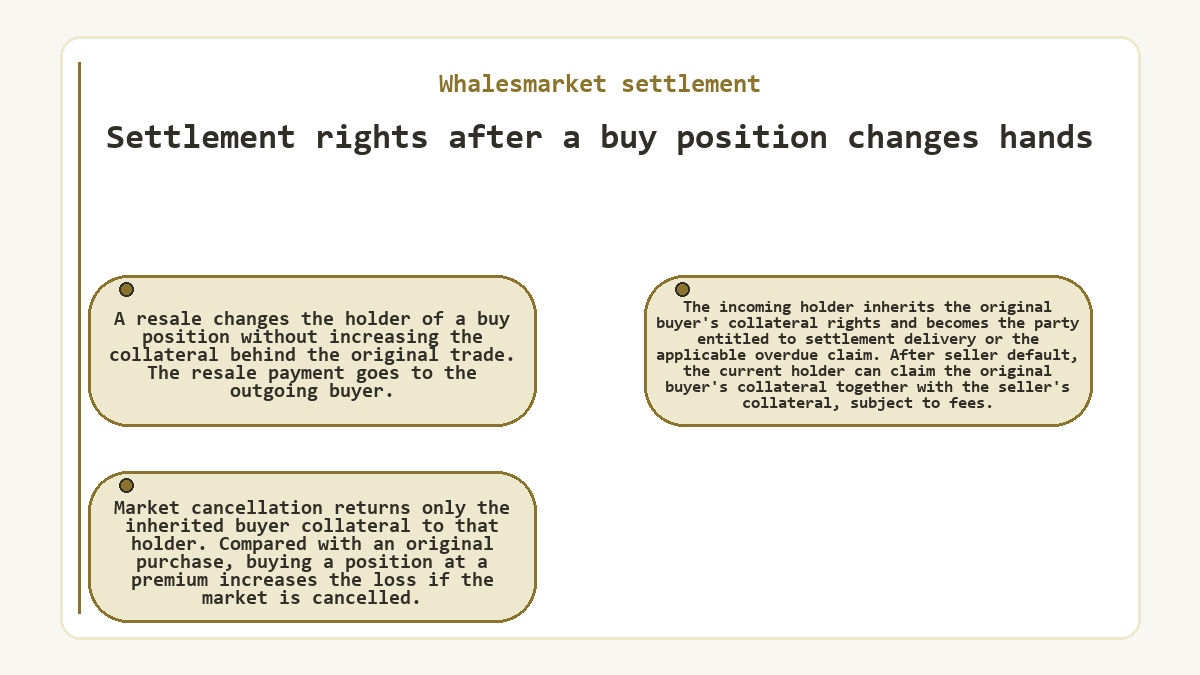
A resale changes the holder of a buy position without increasing the collateral behind the original trade. The resale payment goes to the outgoing buyer. The incoming holder inherits the original buyer's collateral rights and becomes the party entitled to settlement delivery or the applicable overdue claim.
After seller default, the current holder can claim the original buyer's collateral together with the seller's collateral, subject to fees. Market cancellation returns only the inherited buyer collateral to that holder. Compared with an original purchase, buying a position at a premium increases the loss if the market is cancelled.
What to know about Whalesmarket settlement
Can I settle multiple matched orders together in the dashboard?
The dashboard lets sellers select multiple orders for settlement and review their combined token requirement before approval. Each selected order retains its agreed delivery amount. The wallet must have enough of the required tokens for the selection.
Is a resale buyer's settlement fee based on the resale price?
The final settlement fee uses the original trade's notional value, not the later resale price. Under the base fee schedule, the final buyer and original seller each incur 2.5% on that original value. A charge for transferring the resale position is separate from this settlement fee.
Can I change a linked address before receiving a cross-chain settlement?
The pre-market wallet-linking feature does not allow a confirmed linked address to be changed. Check the destination address before confirming a pairing that a settlement route uses. The restriction concerns the linked address and should not be confused with the separate signatures that authorize settlement or bridging.
Does an unfilled offer qualify for a seller-default claim?
Seller-default claims concern matched orders whose token delivery remains overdue. An unfilled offer has no matched delivery obligation for that unfilled quantity. Closing it recovers the creator's unfilled deposit or collateral under the closing-fee rules; it does not cancel the settlement obligations of its matched portions.
Where can I inspect a settlement order from the command line?
The command-line interface (CLI) provides whales orders get for a specific order and whales orders my for the wallet's orders. Inspecting those records does not execute settlement or claim collateral. The whales trade settle and whales trade claim-collateral commands perform those separate actions.
When is the token-purchase fee deducted from an original pre-market order?
The token-purchase platform fee is deducted after successful settlement. Creating or filling an original buy order establishes the commitment first. Cancellation for non-delivery follows its own fee treatment, so the timing of a successful-settlement deduction does not establish the net amount of a default claim.